Lifestyle
LiberLive C1 Review: Who This Stringless Guitar Actually Helps
By GearsClaw Editorial Team | Published August 7, 2026 | Updated August 7, 2026
I did not come to the LiberLive C1 because I wanted a new guitar. I came because I wanted to sing with something under me, and traditional guitar kept saying no.
Sore fingertips. The F chord that never cleaned up. Three weeks of practice that still could not carry one full song without stopping. If you have lived that loop, you already know the real product here is not “a futuristic guitar.” It is a shortcut back to music.
This review digs into how the LiberLive C1 actually feels in the hands, who it is built for, where the hype oversells it, and how it stacks up against other stringless options like LAVA GENIE. The short version: buy it for singing and accompaniment. Do not buy it to become a traditional guitarist.
Key takeaways
- LiberLive C1 is a stringless smart accompaniment instrument, not a traditional guitar trainer.
- The win is immediate song playing: press a chord pad, flick a paddle, keep singing.
- Best fit: singers, absolute beginners, casual creators, and gift buyers who want early success.
- Skip it if you want bends, lead lines, fretting calluses, or DAW-level MIDI production.
- Against LAVA GENIE, C1 feels more song-first and accompaniment-focused; GENIE leans broader sound exploration.
- Current official listing sits around $339 (was $449). The free app is a big part of the value case.
The pain LiberLive is really selling against
Most people do not quit guitar because they hate music. They quit because the first month asks for too many skills at once.
Your fretting hand has to crush steel strings cleanly. Your strumming hand has to keep time. Your brain has to remember chord shapes that still feel like alien geometry. Meanwhile your voice is waiting for support that never arrives. That is why so many guitars end up as furniture.
The LiberLive pitch attacks that exact failure point. No strings. No calluses. No tuning drama before your first song. You unfold the body, press a pad, strum a paddle, and suddenly there is harmonic support under your voice.
That matters psychologically. Early success is not a gimmick for beginners. It is the difference between “I am becoming a musician” and “I bought another expensive reminder that I am busy.” If your goal is accompaniment, not shredding, that framing is the whole product.
What the LiberLive C1 actually is
Call it a guitar-shaped accompaniment machine and you will understand it faster.
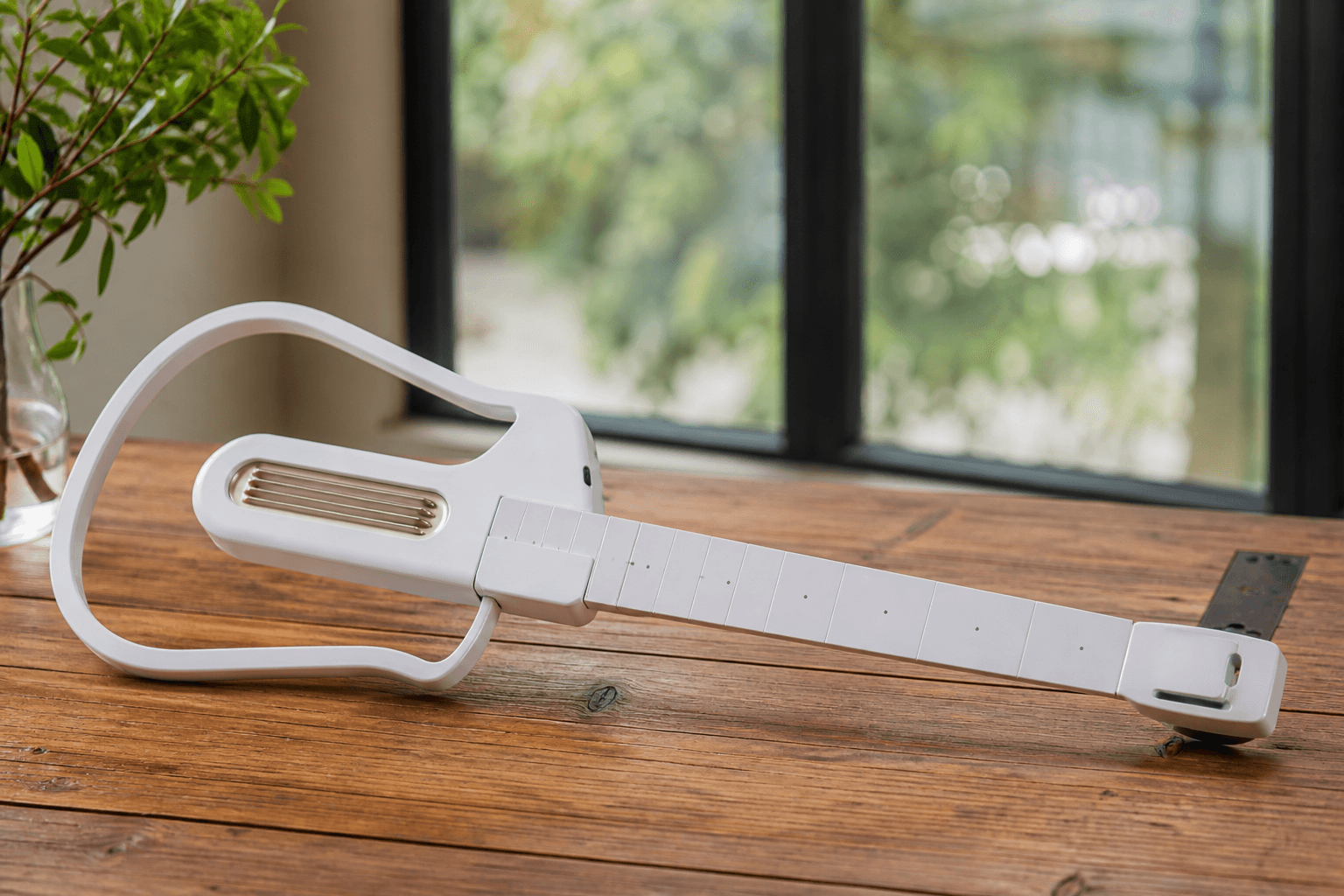
The LiberLive C1 replaces fretted steel strings with pressure-sensitive chord pads on the neck and two metal strumming paddles on the body. Hold a chord region. Flick a paddle. The digital engine plays a chord pattern. Tap the beat pad and you can layer drums and bass-style backing so one person sounds less alone.
It folds down for travel, weighs about 3.94 lb (1788 g), and carries a built-in speaker system: a 5W tweeter plus a 20W subwoofer. Battery life is listed at up to about 6 hours with the onboard speaker, or around 12 hours when you route to an external device. USB-C charging, 3.5 mm line out, and a free companion app with a large song library round out the package.
Official materials also push left-or-right-hand friendliness, because the C1 does not force traditional chord shapes. Playing posture stays consistent: one hand on chord pads, the other on the paddle. That is a real accessibility win for people who bounced off lefty guitar setups or never wanted to rebuild muscle memory twice.
The important honesty check: this is not “Guitar Hero with better plastics,” and it is also not a Martin in disguise. Tech coverage and hands-on reviews keep landing on the same point. The C1 is easiest to love when you stop demanding that it imitate a traditional guitar and start treating it as a portable backing band for your voice.
- Chord pads instead of steel-string fretting
- Metal paddles for strumming or picking patterns
- Onboard speaker for room-ready sound without an amp
- App chord sheets and LED guidance for song following
- Foldable travel form for couches, trips, and small rooms
How it feels to play: the tactile reality
The first five minutes are the test that matters.
You unfold the neck, flip the body into place, power on, and the instrument already feels more “finished product” than toy. Multiple reviewers call out the metal dials, paddle feel, and overall heft. That matters because cheap plastic kills confidence before the first chord. The C1 does not feel like a novelty remote. It feels like hardware someone expected you to keep using.
Chord pads are the emotional unlock. Instead of fighting barre-chord pain, you press a region and the machine knows the harmony. In basic use, the neck maps familiar chord movement. Dig deeper and advanced modes expand each fret zone into minor, seventh, and richer color options. You are not shaping notes with fingertip geometry. You are choosing harmonic places and then timing them.
The paddles are where rhythm lives. Velocity matters. Soft flick and hard flick do not feel identical, so your right hand still has a job. That said, you are usually triggering patterns, not freely picking individual notes. If you come from traditional guitar, your brain may fight this at first. If you come from singing, it feels natural almost immediately: left hand chooses the chord, right hand keeps the groove, mouth does the storytelling.
LED guidance and the app turn the learning curve into a guided lane. Search a song, follow the chord cues, watch the neck lights help your hand land in time. It is closer to karaoke with an instrument than a classical method book. For singers in Reddit-style discussions comparing LiberLive and LAVA GENIE, that guided song path is often the whole reason they are shopping. They do not want theory first. They want a verse that sounds complete tonight.
Then there is the “one person, one band” moment. Tap the beat pad. Drums enter. Bass support locks to your key. Suddenly you are not thin and lonely in a quiet room. You are carrying a pocket arrangement. That is the sensation people remember. Not a perfect blues bend. A full-enough bed for the voice.
The selling points that actually stick
Feature lists are easy. Sticky value is rarer.
First sticky point: day-one music. LiberLive’s strongest claim is not sophistication. It is shortened time-to-song. If you can accompany yourself in minutes instead of months, the product already beat the instrument gathering dust in your closet.
Second: singer-first design. The C1 behaves like a rhythm section that stays in its lane. Transpose from the headstock-style control when your voice needs a kinder key. Layer drums. Switch style packs. Keep the arrangement under the melody instead of competing with it. For vocalists who hate karaoke tracks because they feel canned, this is the appeal: you are still performing the accompaniment with your hands.
Third: the free app story. LiberLive markets 10,000+ songs with no subscription required. In a category where software lock-in can quietly inflate ownership cost, that is a meaningful differentiator. You still need the app for the best experience, and you should expect software quirks like any Bluetooth instrument. But “pay once for the hardware, keep the song tools” is a cleaner pitch than “instrument plus mystery membership.”
Fourth: portability without the soft-case guilt trip. Folded size is backpack-friendly. Unfolded, it still reads as a guitar silhouette for living-room performance energy. Built-in speaker means you can skip the amp ritual. Headphone or line-out options cover quiet nights and louder setups. For travel, camping, dorm rooms, and small apartments, that self-contained loop is the lifestyle fit.
Fifth: giftability. Parents, partners, and friends buy music gifts that look exciting and then create pressure. The C1 lowers that pressure. Someone can open the box and play something recognizable the same evening. That emotional win is why LiberLive keeps showing up in gift and beginner conversations.
LiberLive C1 vs LAVA GENIE: the singer’s fork in the road
If you landed here from singer communities comparing LiberLive C1 and LAVA GENIE, you are asking the right question. Both are stringless. They are not the same job.
Think of LiberLive as a song companion. Chord pads, strum paddles, app-guided sheets, LED cues, and accompaniment tools are organized around getting you into recognizable songs and singing over them. The product story is focused: press, strum, sing.
LAVA GENIE sits closer to a creative sampler-style instrument. Public positioning emphasizes a much larger preset library, tap pads, guiding lights, and AI-assisted song tools. That can be exciting if you want to explore sounds and build more gadget-like arrangements. It can also mean a busier first session if all you wanted was simple chord backing under a chorus.
A practical decision rule works better than brand loyalty. Choose LiberLive if your main sentence is, “I want to accompany my voice tonight.” Choose LAVA GENIE if your main sentence is, “I want a stringless creative surface with lots of sounds and pads.” If your main sentence is, “I want to learn real fretting and picking,” buy neither first. Buy a traditional guitar or a learning add-on.
That framing keeps expectations clean. Stringless instruments are not a moral failure of guitar culture. They are a different lane. Singers comparing both products usually care less about purity tests and more about which device gets out of the way of the song.
| Need | Lean LiberLive C1 | Lean LAVA GENIE |
|---|---|---|
| Fast singing accompaniment | Stronger fit | Possible, but broader |
| Huge preset / sampler energy | Secondary | Stronger fit |
| Simple first-session success | Core promise | Can feel busier |
| Learning traditional guitar technique | Not the goal | Not the goal |
Who should buy it
Buy the C1 if you are a singer who can already carry a melody and just needs honest chord support. Vocalists who do bedroom covers, livestreams, church sing-alongs, cafe open mics, or family gatherings are the clearest match.
Buy it if you are an absolute beginner who wants musical confidence before discipline. There is a valid path where fun comes first and theory comes later. For some people, that is the only path that survives a busy adult schedule.
Buy it if you write songs with your voice first. A portable pad-and-paddle companion can capture harmonic ideas without forcing you into finger-pain homework before the chorus exists.
Buy it as a gift when the recipient loves music but has abandoned traditional guitar once already. The emotional product is permission to try again without repeating the same failure mode.
Also a good fit for left-handed beginners who do not want a specialty lefty instrument hunt. Because chord pads remove conventional shape mechanics, the C1’s same-posture approach is unusually inclusive.
- Singers who need live-feeling backing, not just karaoke tracks
- Beginners who quit after sore-finger week one
- Casual creators making short videos or livestream covers
- Gift buyers who want day-one playability
- Travelers who want foldable, self-contained sound
Who should skip it
Skip the C1 if your dream is lead guitar. There is no shredding lane here. No expressive bends. No note-by-note solo vocabulary in the traditional sense. SlashGear’s review is blunt on this: it is a backing instrument, and creative players who want open-ended control can feel boxed in.
Skip it if you specifically want to learn fretting technique. Pads will not build calluses, barre strength, or classic muscle memory. You can learn rhythm, song form, and harmonic movement. You will not graduate into Travis picking just because the LEDs were helpful.
Skip it if you are a producer shopping for a deep MIDI controller or a DAW-first guitar. Other tools in the smart-guitar category are built for that job. The C1’s center of gravity is performance accompaniment.
Skip it if price is only judged against a traditional electric at the same dollar amount and you already know you want real strings. At roughly $339 on current promo pricing (list often shown near $449), the C1 can look expensive next to beginner acoustics. The comparison only makes sense when you value instant accompaniment and onboard speaker convenience over traditional technique transfer.
And skip it if you refuse to use an app. Basic playing can happen without it, but the song library, deeper sound control, and guided flow are a major part of why people buy this category.
A realistic first-week playbook
Day one should be selfish and simple. Pick one song you already sing well. Set a comfortable key. Choose one guitar pattern and a light drum feel. Do not stack every style pack like a buffet. Your job is coordination: chord hand, paddle timing, breath, lyric.
Day two and three, practice chord changes at talking speed. The C1 removes finger pain, not rhythm responsibility. Coming in early or late on the paddle still sounds awkward. Slow the tempo in the app until your voice and hands agree.
By the end of week one, record a phone video of one full song. Not a perfect take. A complete take. That finish line is the confidence spike traditional beginners often never reach. If you can do that, the instrument is doing its job.
Then expand carefully. Add a second paddle tone. Try a brighter style pack. Move into advanced chord colors only after the basic loop feels automatic. The trap with smart instruments is feature tourism. The win is repertoire.
Limits you should hear before you pay
Pattern-based accompaniment can feel restrictive once the honeymoon ends. You are often triggering musical behaviors more than freely inventing every note. For singers, that can be freedom. For improvisers, it can feel like rails.
Song libraries and app polish matter a lot. Availability and quality can vary by title, and any Bluetooth instrument will have occasional pairing friction. Treat the app as part of the product, not a free extra.
Built-in speakers are impressive for the form factor, but they are not a PA system. Indoor rooms and small gatherings are the sweet spot. Noisy outdoor busking may still want external amplification.
Finally, category confusion creates bad reviews. If you expect a traditional guitar education device, you will write an angry review. If you expect a portable singing companion, you will understand why people get attached. Match the expectation to the machine.
Bottom line
The LiberLive C1 is easiest to recommend when you say the quiet part out loud: you want to make music with your voice, and traditional guitar has been the obstacle, not the dream.
As a stringless smart accompaniment instrument, it is focused, portable, and emotionally smart. Chord pads and paddles get you into songs fast. Drums and style tools make solo singing feel less naked. The free app and foldable body strengthen the lifestyle case.
It is not for everyone. Traditionalists will correctly say it is not a real guitar path. Producers will want more open control. Lead players will bounce off the rails. That is fine. Different job.
If you are the singer who keeps restarting lesson one, or the beginner who wants a song this weekend instead of a callus next month, the LiberLive C1 is one of the clearest modern answers. Buy it for accompaniment joy. Judge it on whether your voice finally has a home.
Frequently Asked Questions
Is the LiberLive C1 a real guitar?▾
It is guitar-shaped and used for guitar-like accompaniment, but it is a stringless digital smart instrument. It does not teach traditional fretting or string technique.
Who is LiberLive C1 best for?▾
Singers, absolute beginners, casual creators, and gift buyers who want to play songs and accompany vocals quickly without learning traditional chord shapes first.
Can beginners play LiberLive C1 on day one?▾
Yes for basic accompaniment. Many first sessions are about pressing chord pads, strumming paddles, and following app or LED guidance. Rhythm still takes practice.
Does LiberLive C1 need a subscription?▾
LiberLive markets the companion app with a large song library and no subscription required. Always confirm current app terms on the official site before buying.
LiberLive C1 or LAVA GENIE?▾
Choose LiberLive if you mainly want song accompaniment for singing. Choose LAVA GENIE if you want a broader stringless sound-exploration and preset-driven creative gadget.
Can left-handed players use LiberLive C1?▾
Yes. LiberLive says there is no separate lefty model; posture stays the same with one hand on chord pads and the other on the strumming paddle.
How long does the battery last?▾
Official specs list up to about 6 hours with the built-in speakers and around 12 hours when using an external device, with USB-C charging.
Will LiberLive C1 replace a traditional guitar?▾
For casual singing accompaniment, it can replace the need for a traditional guitar. For learning fretting, picking, bends, and lead playing, it will not.