WiiM Audio
WiiM Pro vs Pro Plus and Amp Ultra Guide 2026
By GearsClaw Editorial Team | Published September 5, 2026 | Updated September 5, 2026
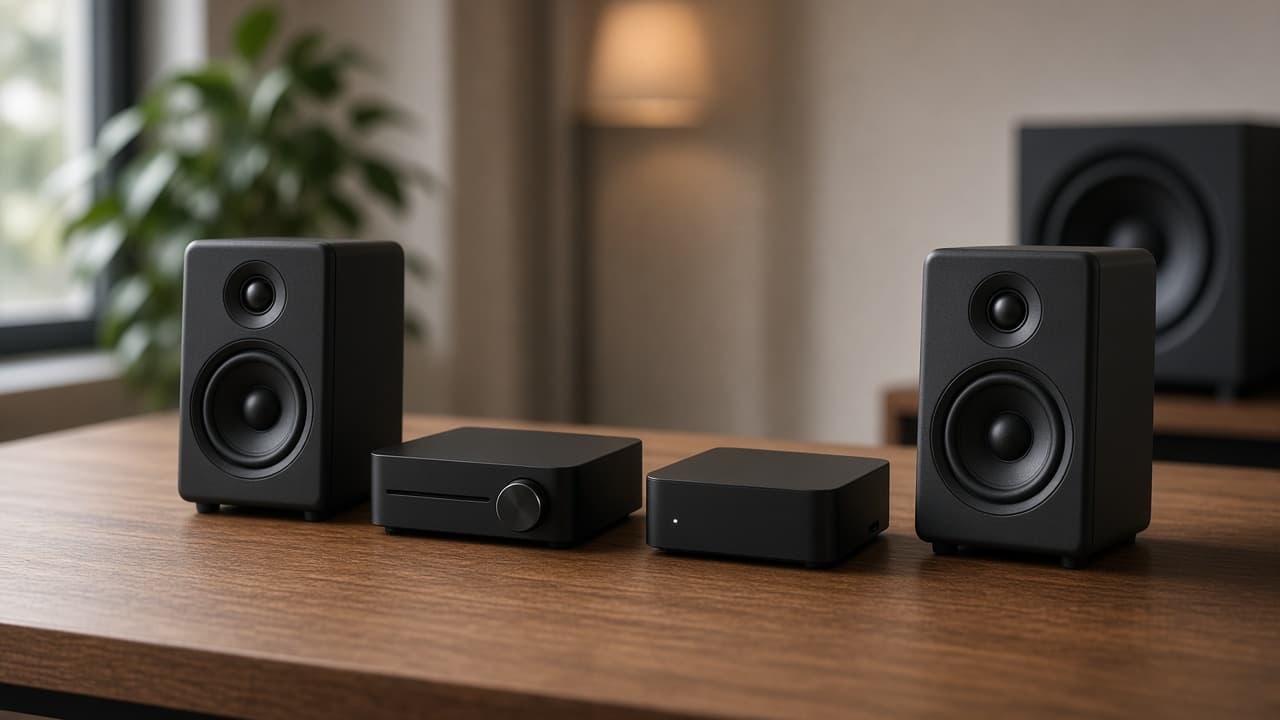
WiiM is one of the fastest paths into modern hi-fi streaming: add a network streamer to speakers you already own, or replace a stack of boxes with one streaming amplifier. This guide focuses on real system roles—WiiM Pro vs Pro Plus, Eversolo Play vs WiiM Amp Ultra, how to choose a WiiM amplifier, and what Sub Pro automatic RoomFit calibration actually changes in a room.
We evaluate from published specs, official feature lists, and recurring owner questions: Do I need the better onboard DAC? Can this box drive my passive speakers? Specs and firmware change, so confirm the current listing before you buy. Disclosure: some links may earn a commission at no extra cost to you; that does not change system-fit advice.
Key takeaways
- Choose WiiM Pro if you mainly use digital outs into an external DAC; choose Pro Plus if you rely on the analog RCA output.
- WiiM Amp Ultra fits buyers who want more power, RoomFit, HDMI ARC, and a strong smart-home multiroom path in one chassis.
- Eversolo Play vs WiiM Amp Ultra is not a pure quality contest: Play leans screen, phono, and local-library ergonomics; Amp Ultra leans power and ecosystem flexibility.
- A WiiM amplifier only makes sense after you confirm speaker impedance, room size, and whether you need TV ARC.
- Sub Pro automatic RoomFit calibration helps bass balance, but speaker placement and crossover settings still matter more than one-tap EQ alone.
How we evaluate WiiM streamers and amplifiers
E-E-A-T for audio gear starts with honest scope. We are not claiming private lab measurements. We match architecture to the rest of the system, check connectivity against daily sources, and separate marketing sample rates from priorities like noise floor, room interaction, and ease of use.
For streamers, the key split is transport versus onboard DAC. Digital outs into a trusted external DAC can make two streamers sound effectively identical; RCA into an amp or active speakers makes the analog stage matter. For amplifiers, we weigh power claims against speaker sensitivity, impedance, listening distance, and HDMI ARC needs—plus whether the app and RoomFit stay pleasant months later.
- Identify what you already own: passive speakers, active speakers, external DAC, TV ARC, or a separate power amp.
- Decide whether the WiiM unit is a digital transport, an analog source, or a full streaming amplifier.
- Confirm music services you actually use, and re-check firmware notes before purchase.
WiiM lineup map: streamer, amp, or power stage
Shoppers often land here after searching for a compact streamer or a wii amplifier style all-in-one. The brand is WiiM. Streamers (Mini, Pro, Pro Plus, Ultra) add app control and line/digital outputs. Streaming amps (Amp, Amp Ultra) also drive passive speakers. A power stage like Vibelink Amp supplies speaker power for a separate streamer.
That map prevents expensive mistakes. Mini cannot drive passive speakers alone. Pro and Pro Plus are streamer/preamp-class. Amp Ultra suits fewer boxes between Wi-Fi and a speaker pair. Vibelink suits owners who like their streamer and need stronger drive. Add Spotify to an existing stereo with a streamer; replace a living-room receiver path with a streaming amp; upgrade amplification alone with a dedicated power stage.
WiiM Pro vs Pro Plus: which streamer should you buy?
The WiiM Pro vs Pro Plus decision is the most common confusion in this lineup because the chassis, app experience, and streaming feature set are intentionally close. Both handle AirPlay 2, Chromecast-class casting where supported, Spotify Connect, TIDAL Connect, and similar service hooks. Both can pass high-resolution PCM over optical or coaxial to an external DAC when configured correctly.
The meaningful gap is conversion quality. Pro Plus upgrades the onboard DAC path (AKM AK4493SEQ in current product materials) and improves the ADC used when you digitize a line-level source for multiroom sharing. If the WiiM box is only a digital transport, Pro often wins on price. If it is your main DAC feeding an amp through RCA, Pro Plus is usually the better long-term buy.
Use Pro when you already trust an external DAC. Use Pro Plus when RCA out is your daily path, you want a quieter background on delicate recordings, or you plan to share analog sources across a WiiM group. Neither replaces a phono preamp if your cartridge needs one. A quick A/B at matched level—Pro Plus analog versus Pro digital into your DAC—usually ends the debate faster than brochure language.
| Decision factor | WiiM Pro | WiiM Pro PlusBest for most |
|---|---|---|
| Best role | Digital transport / flexible streamer | Streamer + stronger onboard DAC |
| Use your own DAC? | Yes — often the smarter value | Less necessary for daily RCA listening |
| Analog input quality | Adequate for many sources | Stronger ADC path for sharing analog sources |
| App and streaming features | Essentially the same family experience | Essentially the same family experience |
| Buy this if… | You already trust an external DAC | RCA out is your primary listening path |
Choosing a WiiM amplifier for speakers and TV
People searching for a wii amplifier usually want a compact streaming amp that powers bookshelf or tower speakers without a full AV receiver. That job belongs to WiiM Amp or Amp Ultra—not the Pro streamers. Start with speaker matching: impedance, sensitivity, room size, and how loud you listen. A modest wattage class can feel effortless with efficient speakers in a small room and strained with demanding 4-ohm towers in a large living room.
Amp Ultra is the higher-power, higher-feature option: premium DAC stage, stronger Class-D amplification, HDMI ARC, app EQ, and RoomFit. It suits one-chassis music-plus-TV systems. The standard Amp remains relevant when budget matters more than peak output. If the TV is a primary source, confirm ARC/CEC behavior and PCM settings; plan a powered sub early if the mains roll off early.
- Buy a streaming amp when you need speaker power plus network music in one box.
- Buy a streamer when you already have amplification you like.
- Prioritize Amp Ultra for TV ARC, room correction, and higher output needs.
- Treat RoomFit as fine-tuning after solid speaker placement.
Eversolo Play vs WiiM Amp Ultra: which all-in-one wins?
The Eversolo Play vs WiiM Amp Ultra comparison is the right fight when you want one streamer-amplifier chassis and must choose a philosophy. Both combine DAC, streaming, amplification, HDMI ARC-class TV use, and hi-res service playback. The split is interface habits, vinyl needs, power headroom, and ecosystem value.
Amp Ultra usually wins for continuous power, smart-home/multiroom flexibility, RoomFit, and a remote-forward workflow—especially if you already own other WiiM endpoints. The smaller display is secondary; the app and voice remote carry daily control. Eversolo Play usually wins for a larger touchscreen library browser, integrated MM/MC phono, and less phone dependency. Verify regional Play options (Apple Music, CD bundles) before assuming feature parity.
Read wattage carefully. Amp Ultra’s higher published power class means more headroom for difficult speakers or larger rooms—not an automatic sound-quality win. Play’s screen and phono convenience can matter more if your speakers are efficient and vinyl is nightly. Verdict: Amp Ultra for power and WiiM ecosystem scale; Play for on-device browsing and phono. List three non-negotiables and let that list break the tie.
| Priority | Lean WiiM Amp UltraBest for most | Lean Eversolo Play |
|---|---|---|
| Speaker power headroom | Usually stronger fit | Often enough for efficient speakers |
| On-device touchscreen browsing | Secondary to app/remote | Core strength |
| Built-in phono (MM/MC) | Not the Amp Ultra path | Major advantage |
| WiiM multiroom ecosystem | Native advantage | Different ecosystem |
| Room correction / smart features | RoomFit and broad smart hooks | Strong, but different feature mix |
| Best for | Power + ecosystem all-in-one | Screen-first hi-fi lifestyle amp |
Sub Pro automatic RoomFit: smarter bass without extra boxes
Bass is where many compact systems fall apart. The WiiM Sub Pro targets that gap as a wireless smart subwoofer with a Class-D amp, an 8-inch long-throw driver, and deep extension into the mid-20 Hz range per current materials. For shoppers searching sub automatic setups, the headline is RoomFit: it analyzes the room and applies correction so the sub is less likely to boom in one seat and disappear in another.
Automatic is not placement-proof. Choose a sensible near-wall position, keep the cabinet clear of soft furniture traps, then run RoomFit from the main seat in a quiet room. Set crossover, phase, and level so the sub supports the mains. Wireless pairing joins compatible WiiM streamers and amps without a long sub-out cable; RCA remains for reliability or third-party gear. Official docs note Vibelink Amp is not a Sub Pro partner—plan differently for that stack.
- Use Sub Pro automatic RoomFit after basic placement, not before.
- Prefer wireless for clean installs; use RCA when stability demands it.
- Match crossover to your mains; confirm compatibility before ordering.
Recommended builds by listening scenario
Active desktop or apartment speakers: Pro for digital handoff, Pro Plus for polished RCA. Living-room music and TV with passive bookshelves: Amp Ultra keeps HDMI ARC, streaming, and power together—then decide if Sub Pro automatic calibration is worth the floor space. Existing high-end DAC and amp: buy Pro as a transport. Vinyl-plus-streaming: shortlist Eversolo Play for phono and screen, or pair a WiiM streamer with a separate phono stage. Multiroom homes should standardize on one ecosystem when possible.
Final verdict: buy for system role, not hype
WiiM compresses features that used to need a rack—but only if you buy the right role. WiiM Pro vs Pro Plus is mostly a DAC-path decision. A WiiM amplifier such as Amp Ultra drives speakers and often handles TV audio. Eversolo Play vs WiiM Amp Ultra is a lifestyle and feature-balance choice, not a single-score shootout. Sub Pro automatic RoomFit is the cleanest in-family path to deeper bass when placement and crossover stay disciplined.
Shortest path: Pro Plus for analog-out streaming into an existing amp; Amp Ultra for an all-in-one music-and-TV room with passive speakers; Sub Pro when you need authoritative low end without another brand’s calibration maze. Confirm current specs on the official store before checkout.
Frequently Asked Questions
What is the real difference in WiiM Pro vs Pro Plus?▾
Streaming features are closely matched. Pro Plus upgrades the onboard DAC and analog conversion path, so it is the better pick when you listen through RCA analog outputs. Pro is often enough if you use optical or coaxial into an external DAC.
Can a WiiM Pro or Pro Plus power passive speakers?▾
No. They are streamer and preamp-level sources. You need powered speakers, an integrated amplifier, a receiver, or a separate power amplifier. For a one-box WiiM amplifier solution, look at Amp or Amp Ultra.
Who wins Eversolo Play vs WiiM Amp Ultra?▾
Amp Ultra is usually stronger for power headroom and WiiM ecosystem integration. Eversolo Play is usually stronger for large-screen on-device browsing and built-in phono convenience. Pick by your top non-negotiables, not by a generic score.
What do people mean when they search for a wii amplifier?▾
They almost always mean a WiiM streaming amplifier that can drive passive speakers while handling network music and often TV ARC. Confirm exact model names, because WiiM streamers and WiiM amplifiers are different product classes.
Does Sub Pro automatic RoomFit replace careful sub placement?▾
No. Automatic calibration improves balance after sensible placement. Start with a stable position, clear boundary conditions, and a quiet measurement, then use RoomFit plus crossover and level controls to blend the sub with your main speakers.
Is Amp Ultra better than buying Pro Plus plus a separate amp?▾
Amp Ultra is simpler and often better for TV ARC living rooms. A Pro Plus plus separate amplification stack can win if you already own a strong amp or want to upgrade amplification independently later.
Do I need 24-bit/192kHz support to enjoy WiiM?▾
No. High-resolution support is useful when your service and files provide it, but speakers, room acoustics, placement, and clean gain staging usually matter more than the maximum sample-rate badge.